Concept Coursework / AR Board Game · 2026
Video DemoChaos Stock — markets move on the table.
A fully offline commodity-trading board game enhanced by a Unity companion app for card reference and optional augmented-reality scans.
01 · Overview
What the project is
Chaos Stock began as our team's original coursework idea: a commodity-trading game that can be played completely offline with its physical board, money, commodity cards, event cards, and scenario cards. The Unity companion app extends the experience without becoming a requirement for completing the game.
02 · Approach
How I approached it
The game was developed with guidance from a lecturer experienced in board-game design. We kept negotiation, market movement, price tracking, and player decisions on the table. The companion app is deliberately secondary: it makes the card library easier to explore and adds AR detail to commodity cards while preserving the social rhythm of an offline board game.
03 · Implementation
From interface to system
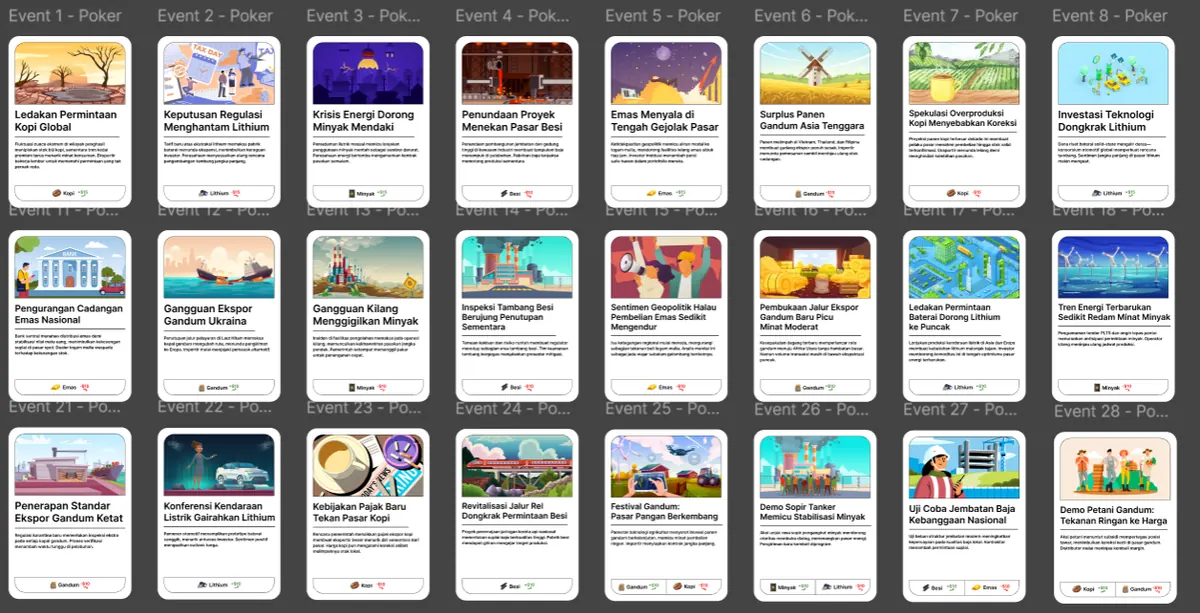
The physical kit includes a market board, six commodity types, multiple money denominations, and separate event and scenario decks. Built in Unity, the companion app catalogs the available event and scenario cards. Players can also scan commodity cards to reveal an explanation and a matching 3D object—such as coffee or gold—through augmented reality.
04 · Gallery
Product views
05 · Outcome
What changed
The result is a playable hybrid prototype supported by a complete physical kit, a Unity-based AR companion, and a recorded guide. Chaos Stock was recognized as one of the course's top projects and was later presented at the study program's project showcase.
06 · Learning
What I learned
This project showed me that AR works best when it strengthens the core interaction instead of becoming a requirement for every turn. Keeping the market mechanics physical made the game social and tangible, while selective scanning gave the digital layer a clear purpose.
Project links