Independent / Full-stack Product · 2026
Private BetaValrify — safer account trading.
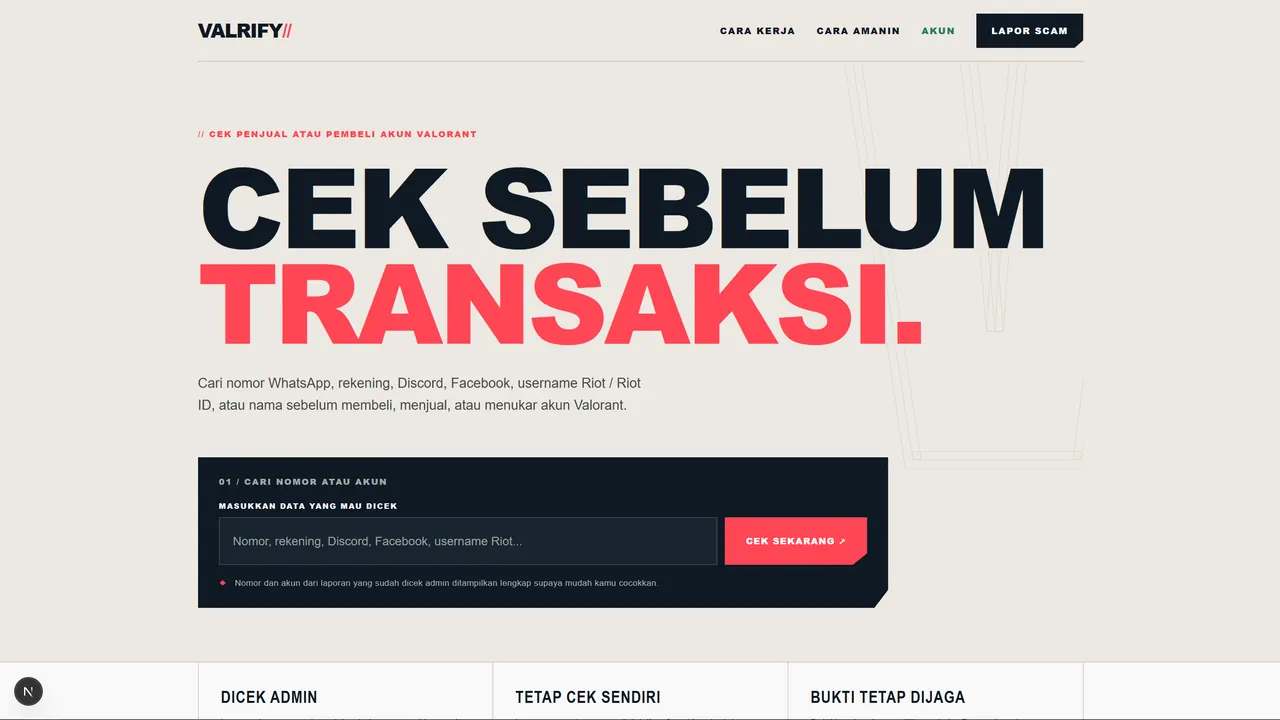
A community-driven platform designed to improve trust and transparency in Valorant account trading.
01 · Overview
What the project is
Valrify began from my own experience buying and selling Valorant accounts and seeing recurring scams and hack-back cases in the community. Transaction history is often scattered across chats, social posts, and private groups, so the product brings searchable identifiers, reviewed reports, transaction confirmations, and community context into one reputation profile—without presenting the platform as a guarantee of safety or a legal authority.
02 · Approach
How I approached it
I shaped the product around evidence, neutrality, and privacy. Reports move through a controlled review workflow before publication; raw evidence and reporter identities stay private; and public identifiers are normalized, linked, or masked according to explicit rules. Search supports the identity types people actually encounter before a transaction, from Riot IDs and usernames to phone, bank, and e-wallet details.
03 · Implementation
From interface to system
Valrify is a TypeScript monorepo with a Next.js and React web app backed by a NestJS REST API. PostgreSQL and Drizzle model users, entities, identifiers, reports, evidence, moderation history, transaction confirmations, community activity, and notifications. Shared domain and validation packages keep normalization, role permissions, risk labels, and schemas consistent across the system. Evidence can be stored locally in development or in a private Cloudflare R2 bucket, while targeted rate limits protect authentication, search, uploads, and submissions.
04 · System flow
How the pieces connect
A simplified view of the implemented product flow—not a claim about infrastructure that is not public.
- 01
Search
Normalize the identifiers people use before trading
Next.js - 02
Report
Collect structured claims and private evidence
NestJSR2 - 03
Review
Apply moderation, privacy, and publication rules
PostgreSQLDrizzle - 04
Reputation
Connect reviewed reports and transaction context
Shared domain rules
05 · Gallery
Product views
06 · Outcome
What changed
The active beta now supports the core end-to-end flows: identity search, evidence-backed reporting, admin review and publication, reputation profiles, positive transaction confirmations, authentication, notifications, and community discussion. Seeded demo records remain fictional while the product is tested and refined.
07 · Learning
What I learned
Building a trust-sensitive product required more than a polished interface. The key lesson was to encode moderation states, attribution, identifier visibility, and privacy boundaries as shared domain rules, so the web app and API cannot quietly drift into different interpretations of what is safe to expose.
Project links
Live site and repository links are not public yet.